

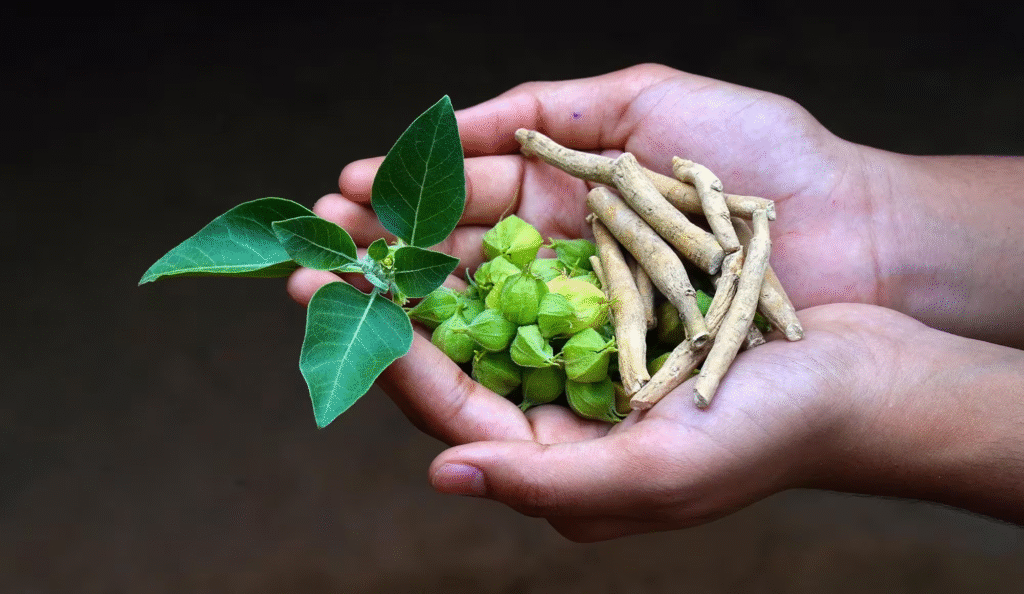
Ashwagandha (Withania somnifera) has been a cornerstone of Ayurveda for over a thousand years. Known as a powerful Rasayana, it is traditionally used to support strength, resilience, immunity, and mental balance. Yet in recent years, Ashwagandha has become the subject of confusion, controversy, and safety debates—especially in the global wellness market.
At Jeevalaya, we believe this confusion doesn’t come from the herb itself, but from how it is being used today.
What Ayurveda Has Always Said About Ashwagandha
Classical Ayurvedic texts are very clear on one point:
👉 Only the root of Ashwagandha is recommended for internal use.
For centuries, Ayurvedic physicians have prescribed the root, not the leaves, stems, or berries. This principle is not a matter of tradition alone—it is supported by both historical usage and modern scientific evaluation.
The Ayurvedic Pharmacopoeia of India and the Ministry of AYUSH clearly define Ashwagandha as the dried mature root of Withania somnifera.
At Jeevalaya, this distinction matters deeply, because Ayurveda is not about shortcuts—it is about precision.
Why Safety Concerns Started Appearing
During the COVID-19 pandemic, Ashwagandha saw a massive global surge in demand, especially as a “stress-relief” and “immune-boosting” supplement. Unfortunately, this demand also led to:
- Over-the-counter self-medication
- Use of non-traditional plant parts, especially leaves
- Poor-quality, unregulated formulations
- High dosages without personalization
Some international safety reports raised concerns about liver health, thyroid stimulation, and hormonal effects. However, expert reviews—including those commissioned by the Government of India—found that many of these concerns were based on:
- Studies using Ashwagandha leaves, not roots
- Animal or lab-based data without clinical correlation
- Products with multiple herbs or contaminants
In Ayurveda, context is everything—the right herb, the right part, the right dose, and the right person.
The Jeevalaya Insight: Ayurveda Is Personal, Not Generic
One of the biggest misunderstandings today is treating Ashwagandha like a “one-pill-for-all” supplement.
At Jeevalaya, we see Ashwagandha not as a trend, but as a therapeutic tool that must align with:
- Your prakriti (body constitution)
- Your current imbalance (vikriti)
- Your digestive strength (agni)
- Your lifestyle, stress levels, and sleep patterns
For example:
- Someone with chronic stress and poor sleep may benefit
- Someone with untreated hyperthyroid symptoms may need caution
- Someone with liver sensitivity may require alternatives or lower doses
Ayurveda never recommends blind consumption—even of powerful herbs.
What Official Guidelines Reinforce
The Ministry of AYUSH has issued clear guidance advising against the use of Ashwagandha leaves in formulations due to insufficient safety evidence. Their position reinforces what Ayurveda has always practiced:
✔ Use the root
✔ Ensure quality and purity
✔ Follow proper dosage
✔ Use under professional guidance
This aligns perfectly with Jeevalaya’s philosophy of safe, conscious, and individualized healing.
So, Is Ashwagandha Safe or Not?
The honest answer is:
Ashwagandha is safe when used correctly—and risky when used carelessly.
Thousands of years of traditional use and modern clinical data support the safety of standardized Ashwagandha root, especially when prescribed responsibly.
Problems arise when:
- It is self-prescribed for long periods
- Taken in excessive doses
- Sourced from poor-quality supplements
- Used without understanding the body’s signals
Jeevalaya’s Closing Thought
At Jeevalaya, we don’t believe in fear-based wellness—or hype-based wellness.
We believe in informed Ayurveda, where ancient wisdom meets modern understanding, and where herbs like Ashwagandha are used with respect, not recklessness.
Healing is not about consuming more.
It is about consuming right.If you are considering Ashwagandha, let it be a conversation with your body, not just a capsule on your shelf 🌿
jeevalaya #nakshatras #jeevalaya bangalore #jeevalaya retreat centre #jeevalaya whitefield #mental wellness #property healing #Ayurveda #Counseling #Medical astrology
External link – https://en.wikipedia.org/wiki/Ayurveda
Internal link – https://jeevalaya.co.in/ayurvedic-self-care-rituals-for-mental-well-being/